

Knowledge Pattern의 기초(01)


CreateOrModifyDatum
This method is only used in the Knowledge Pattern Feature.
Enables you to create or modify a datum.
-datumType: Indicates the datum type: Point, Line, Curve, Circle, Surface, Plane, Volume..
-Destination: Indicates the destination feature (PartBody, ...).
-PatternList: Indicates the pattern list.(The Knowledge Pattern List that should track the geometry)
-IndexInPatternList: Indicates the index number in the pattern list.
Rule Example(03) : Create a Loop in a Rule
Case1.
Let x(Point)
for x inside `ListTest`
{
if (x.GetAttributeReal("X") < 0.02)
x.SetAttributeReal("Z",0.10)
else
x.SetAttributeReal("Z",0.01)
}

case 2.
let i = 1
let x(Point)
for i while i<=`ListTest` .Size()
{
x = `ListTest` .GetItem(i)
if (x.GetAttributeReal("X") < 0.01)
x.SetAttributeReal("Z",0.1)
else
x.SetAttributeReal("Z",0.2)
}

Collect Points(alternative) : Create formula that will automatically fill in the list
1.Click the Formula icon to Create List
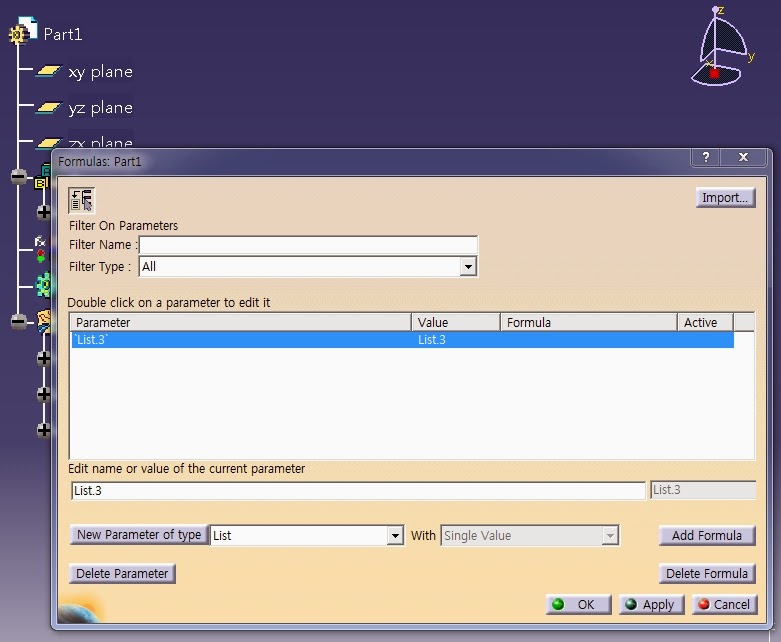
2. Click the Add Formula. The Formula Editor is displayed.
3. OpenBodyFeature.Query("Point",""). Click OK twice when done.

4. You can find "List.3=OpenBodyFeature.Query("Point","")"

5. Click "OK" when done. The formula is added to the Relations tree

2. Click the Add Formula. The Formula Editor is displayed.
3. OpenBodyFeature.Query("Point",""). Click OK twice when done.
4. You can find "List.3=OpenBodyFeature.Query("Point","")"
5. Click "OK" when done. The formula is added to the Relations tree
Rule Example(02): Collect Points(in OpenBodyFeature) to List
Let tmpList(List)
Let tmpList2(List)
Let tmpPoint(Point)
Let I (Integer)
Set I=1
tmpList = `PointTest` .Query("Point","")
For I While I<= tmpList.Size()
{
tmpPoint = tmpList.GetItem(I)
If tmpPoint.IsRoot == true
{
tmpList2.Append(tmpPoint)
}
}
`List_PTG` = Copy(tmpList2)

Let tmpList(List)
Let tmpList11A(List)
Let tmpList11B(List)
Let tmpList12(List)
Let tmpList21(List)
Let tmpList22(List)
Let tmpCrv(Curve)
Let I (Integer)
Set I=1
tmpList = `Series\Type-TB` .Query("Curve","")
※ 외부리스트로 처리하지말고 내부적으로 처리할것(속도차이에 매우 유리함)
For I While I<= tmpList.Size()
{
tmpCrv = tmpList.GetItem(I)
If tmpCrv.Name == "11A_UPPER_Flange_BaseLine-A"
{
tmpList11A.Append(tmpCrv)
}
else if tmpCrv.Name == "11B_UPPER_Flange_BaseLine-B(LvDown)"
{
tmpList11B.Append(tmpCrv)
}
else if tmpCrv.Name == "12_UPPER_Web-EndLine"
{
tmpList12.Append(tmpCrv)
}
else if tmpCrv.Name == "21_UNDER_Flange_BaseLine"
{
tmpList21.Append(tmpCrv)
}
else if tmpCrv.Name == "22_UNDER_Web-EndLine"
{
tmpList22.Append(tmpCrv)
}
}
`11A_UPPER_Flange_BaseLine-A` = Copy(tmpList11A)
`11B_UPPER_Flange_BaseLine-B(LvDown)` = Copy(tmpList11B)
`12_UPPER_Web_EndLine` =Copy(tmpList12)
`21_UNDER_Flange_BaseLine` =Copy(tmpList21)
`22_UNDER_Web-EndLine` =Copy(tmpList22)
Let tmpList2(List)
Let tmpPoint(Point)
Let I (Integer)
Set I=1
tmpList = `PointTest` .Query("Point","")
For I While I<= tmpList.Size()
{
tmpPoint = tmpList.GetItem(I)
If tmpPoint.IsRoot == true
{
tmpList2.Append(tmpPoint)
}
}
`List_PTG` = Copy(tmpList2)
Let tmpList(List)
Let tmpList11A(List)
Let tmpList11B(List)
Let tmpList12(List)
Let tmpList21(List)
Let tmpList22(List)
Let tmpCrv(Curve)
Let I (Integer)
Set I=1
tmpList = `Series\Type-TB` .Query("Curve","")
※ 외부리스트로 처리하지말고 내부적으로 처리할것(속도차이에 매우 유리함)
For I While I<= tmpList.Size()
{
tmpCrv = tmpList.GetItem(I)
If tmpCrv.Name == "11A_UPPER_Flange_BaseLine-A"
{
tmpList11A.Append(tmpCrv)
}
else if tmpCrv.Name == "11B_UPPER_Flange_BaseLine-B(LvDown)"
{
tmpList11B.Append(tmpCrv)
}
else if tmpCrv.Name == "12_UPPER_Web-EndLine"
{
tmpList12.Append(tmpCrv)
}
else if tmpCrv.Name == "21_UNDER_Flange_BaseLine"
{
tmpList21.Append(tmpCrv)
}
else if tmpCrv.Name == "22_UNDER_Web-EndLine"
{
tmpList22.Append(tmpCrv)
}
}
`11A_UPPER_Flange_BaseLine-A` = Copy(tmpList11A)
`11B_UPPER_Flange_BaseLine-B(LvDown)` = Copy(tmpList11B)
`12_UPPER_Web_EndLine` =Copy(tmpList12)
`21_UNDER_Flange_BaseLine` =Copy(tmpList21)
`22_UNDER_Web-EndLine` =Copy(tmpList22)
Rule Example(01) :Change Object Name
0. 해당구문의 형식은 아래와 같음
Let newname(String)
newname='Input String'
'Input Object'.Name=newname
Let newname(String)
newname='Input String'
'Input Object'.Name=newname


피드 구독하기:
글 (Atom)